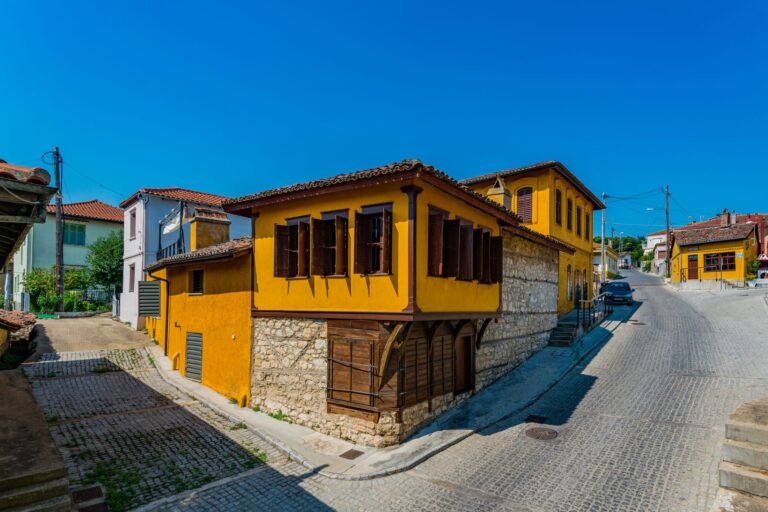
The Old Town of Xanthi is one of the largest traditional settlements remaining today in Greece that maintains its urban fabric, cobbled streets, small squares and buildings exactly as they were during their heyday from mid 19th to early 20th century. Spread over the northern part of the city and covering an area of 380.000 sq.m., it represents Xanthi’s traditional core. Due to renovation work done on the surroundings and on Town Halls over the last couple of years, the Old District has emerged as one of the best-preserved architectural complexes in all of Northern Greece. The Old Town was designated a traditional settlement in 1978.
The buildings surviving in the Old Town were built by the end of the 19th century immediately after the devastating earthquakes, which took place in 1929 and had leveled everything. The period of their reconstruction coincided that of the economic growth of the city, which emanated from the prosperous tobacco trade. Tobacco merchants, and mainly the bourgeoisie of the multicultural city, namely Greeks, Turkish, Jews as well as other Europeans, built luxurious mansions using builders, craftsmen and artists from Western Macedonia and Epirus. Along with the mansions came other important buildings serving religious purposes (churches, mosques) and education (schools, boarding houses), housing civil authorities (town hall, banks, consulates, clubs, administration) and culture (theatres, cinemas, private collections, conservatoires, cabarets), altogether forming an organized and prosperous society. There were, also, many elegant two-storey houses inhabited by tobacco workers and the city’s middle class.
In terms of architectural style, buildings exhibit a wide variety. Walking along the Old Town, one comes across traditional Balkan architecture, but, also, a blend of neoclassicism and eclecticism (a mix of European architectural styles of the 19th century). As stated by scholars, researching the architectural wealth of Xanthi, the Old Town represents a diverse architectural panorama of Eclecticism, Bell Epoch, the Italian Renaissance, German Romanticism and Greek Neoclassicism. All the listed buildings reflect the influence and the aesthetic sensitivities that their wealthy owners had carried with them from the cosmopolitan centers of Europe, the Balkans, Athens, Constantinople and Smyrna.