
Amphipolis Archaeological Park

Ancient_icon

Amphipolis Archaeological Park

Amphipolis, built on the hillsides near the delta of the river Strymon, is one of the major cities of Macedonia. It was founded as a colony of the Athenians in 422 BC and, during the Peloponnesian War, it became a place of conflict in which the leaders of rival Athens and Sparta Cleon and Brasidas were killed. Amphipolis was occupied in 358 BC by King Philip of Macedonia and became the seat of the Royal Mint, whereas the port of the city was the starting place for the fleet of Alexander the Great on the Asia Minor expedition. During the Roman period it was the capital of one of the four administrative regions of Macedonia. Amphipolis, a large hub of the Egnatia highway, was traversed by the Apostle Paul and in the early centuries of Christianity it was a seat of a bishopric which was under the Diocese of Thessaloniki. The Christian Amphipolis flourished during the 5th and 6th centuries. The city was destroyed by enemy raids in the 7th century and was finally abandoned during the 8th-9th century. The excavations that began in 1956 brought to light the ancient and early Christian city with fascinating architecture and movable findings. The archaeological site of Amphipolis is surrounded by monumental walls of the classical and Hellenistic period at a length of 7.5 km with towers and fortified gates. Outside the gate C of the north wall still stand the piles of a wooden the bridge of river Strymon, as described by the historian Thucydides. From the ancient public buildings, both the gymnasium and the palaestra of the ancient city have been excavated, along with the “Xystus,” a covered arcade for races. The sanctuaries of Clio, Thesmoforio or Nymphaeum have also been revealed. Private residences of the 4th century BC and the Roman period that had frescoes and mosaics have also been found. At the site of the ancient acropolis, which was converted by the Christians in the religious centre, the remains of four basilicas of the 5th and 6th centuries were brought to light, bearing rich mosaic floors with geometric patterns and zoomorphic representations. A remarkable sight in the same area is also a centrally planned church dating from the 6th century. The findings of Amphipolis and the rich grave goods from the tombs in the cemetery of the city, dated back to the 4th to the 2nd BC century, are kept in the important archaeological museum in Amphipolis.

More Places

Finiki

The village of Foiniki is the best-preserved traditional settlement in Thesprotia. A number of 18th century two- and three-storey manor

Read more...

Preveza

Preveza is the princess of the Ambracian Gulf, built at the mouth of the enclosed bay and overlooking the Ionian

Read more...
Rotonda historic monument Thessaloniki Central Macedonia Greece

Rotunda

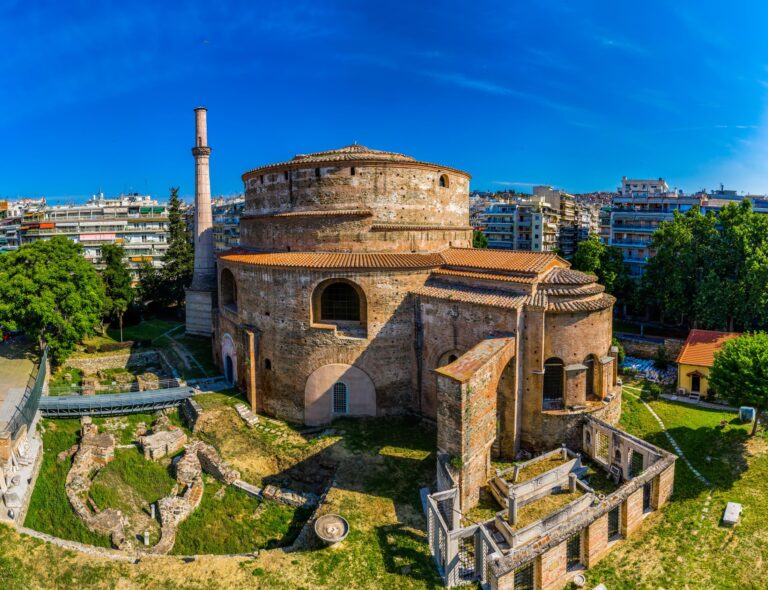
Rotunda is a pericentral construction, unique in Greece. It was part of the palace complex built by Cesar Galerius in

Read more...

Lake of Aoos

The Aoos Springs Lake, 20 kilometres north-west of Metsovo, was created in the 1980s when dams were built to produce

Read more...

Drama

Drama is a city with a rich history, unique natural beauty and great architectural heritage. From antiquity to modern times,

Read more...